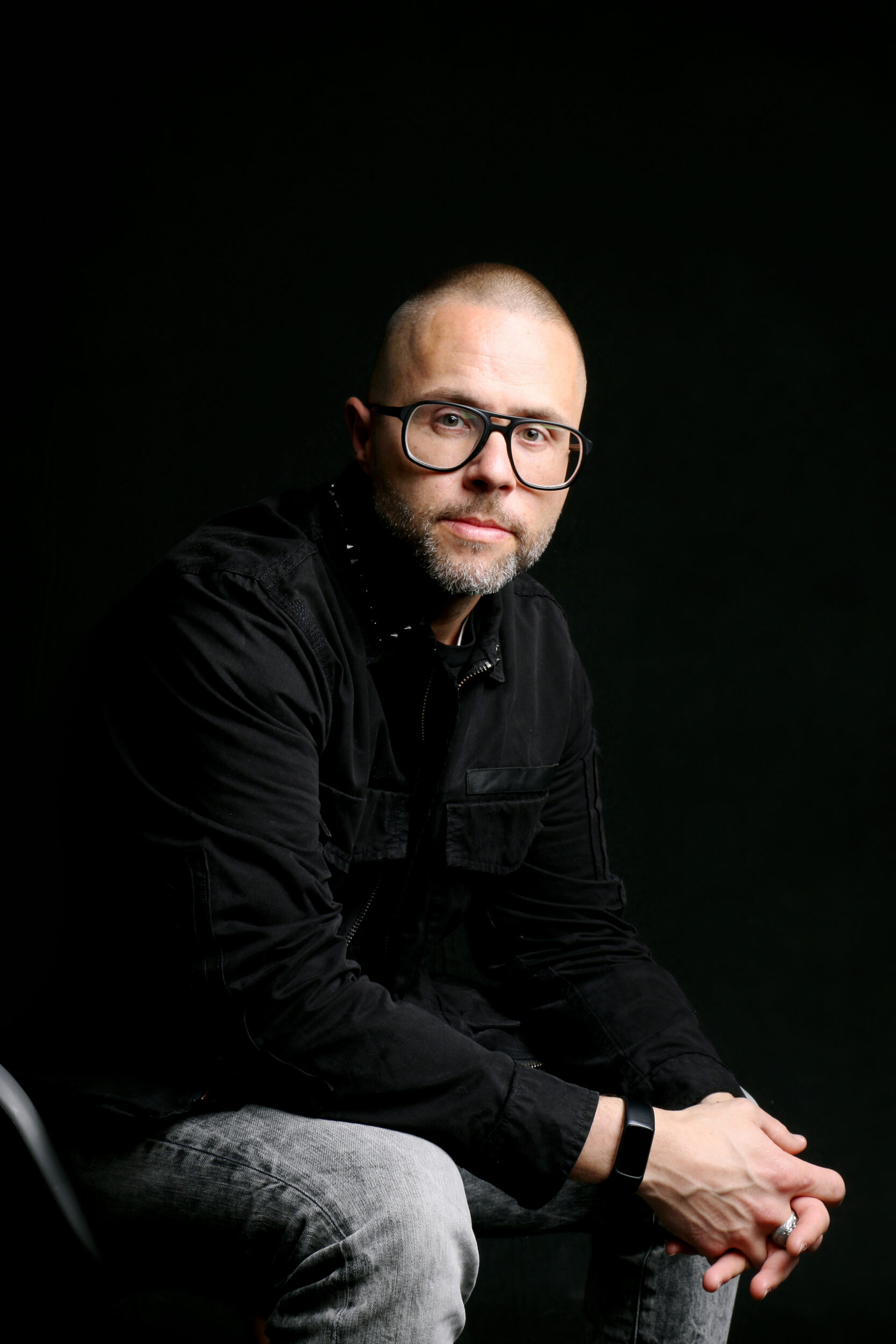
Zack O’Malley Greenburg is an author of five books, including biographies and business histories, and a former Forbes senior editor. His writing has appeared in The New York Times, Rolling Stone, and Vanity Fair. Zack wrote the JAŸ-Z biography ‘Empire State of Mind.’
The Hip Hop Museum caught up with Zack to talk about his JAŸ-Z-related donations to The Museum, writing ‘Empire State of Mind’, and what fascinates Zack about Jay.
Adam Aziz: Can you start off by introducing yourself?
Zack O’Malley Greenburg: My name is Zack O’Malley Greenberg I am an author of several books about the business of entertainment.
I got my start at Forbes magazine right out of college in 2007. It was probably a few weeks after I started, and an editor walked into my cubicle, and she said, “Do you like Hip Hop?” I said, “I love Hip Hop.” She said, “Great, you’re going to help me do the first-ever list of the top-earning rappers in the world.” I said, “Great.” I didn’t really know what I was doing, but I helped her eventually put this thing together and I ended up writing an article about how 2Pac, at the time, was making more money dead than all but a few living rappers. The top three living rappers at the time were JAŸ-Z, Diddy, and 50 Cent. We finished the reporting, and in those days, I was at the magazine, and the magazine and Forbes.com were separate entities, so you never really knew when the thing would go live online.
A few weeks later, I was driving around the desert, reporting some other story, and on the radio comes, “Forbes, 1, 2, 3, I get money, I get money,” and it was the Forbes billion-dollar remix, and the top three guys had all gotten together to basically make a song about my article.
AA: What inspired you to write a book on JAŸ-Z? What are two or three of the most surprising things you learned about Jay when writing the book?
ZOG: I was inspired to write a book on Jay because an editor at Penguin called me and said, “Would you like to write a book on Jay?” And I said, “Of course.” I don’t know if she knew exactly how old I was at the time. I was, I think, 25 or 26. I had no idea how to write a book. I said I would take whatever advance they wanted to offer me and go do my thing.
I kind of figured out how to write a book, and in a funny way, it’s, you know, I knew how to write a magazine feature, and writing a book with 12 chapters is kind of like writing 12 magazine features, except you have to stitch it together in sort of an interesting way. And that’s sort of how I approached it, um, and that’s been my style as a writer that’s developed over the years.

In reporting the book, you know, it was interesting. He (Jay) didn’t cooperate, like he didn’t agree to cooperate, but he never declined officially either. And while I was reporting, I was kind of worried that he would try to stop people from talking to me if he ended up not talking to me. And I was trying for the whole time to get him to talk to me through John Meneilly, who was then his consigliere, because Jay didn’t like to say that he had a manager, and he was indeed running his own show. I talked to John Meneilly a few times, and he was sort of like, “Yeah, maybe, maybe,” and then, you know, I had to turn in my book. I never ended up talking to him for the book, but he didn’t seem to get in the way of anybody talking to me either.
The most surprising thing I learned about Jay, maybe it’s not really a surprise, but it’s more like you just kind of see a pattern. He really has a pattern of sort of, or he did 5 or 10 years ago, of sort of never acknowledging defeat. “I will not lose ever.” And, you know, you see him only rapping about the things that worked and not really focusing on anything that didn’t work. So that’s maybe not a surprise, but what did surprise me was how valuable the lessons were from the things that didn’t work. There were a lot of things that didn’t work; that was a surprise. And then, you know, what he learned from them, that was also a surprise. And those ended up being some of the most compelling chapters in the book. And later in his career, you would start to hear him say things like, “A loss ain’t a loss, it’s a lesson.”
I think a really good example of that was the JAŸ-Z Jeep. There were some discussions to have this is in the early aughts. A JAŸ-Z Jeep Commander painted a special patented color of JAŸ-Z Blue with all these specifications that were picked by Jay. It would come fully loaded with an audio system with all of his music, and it didn’t happen in the end because one of the executives thought that it was too risky to associate with this former underworld guy, and it felt too dangerous, so the whole thing fell through.
AA: Can you talk about the donation of the JAŸ-Z painting you made to The Museum?
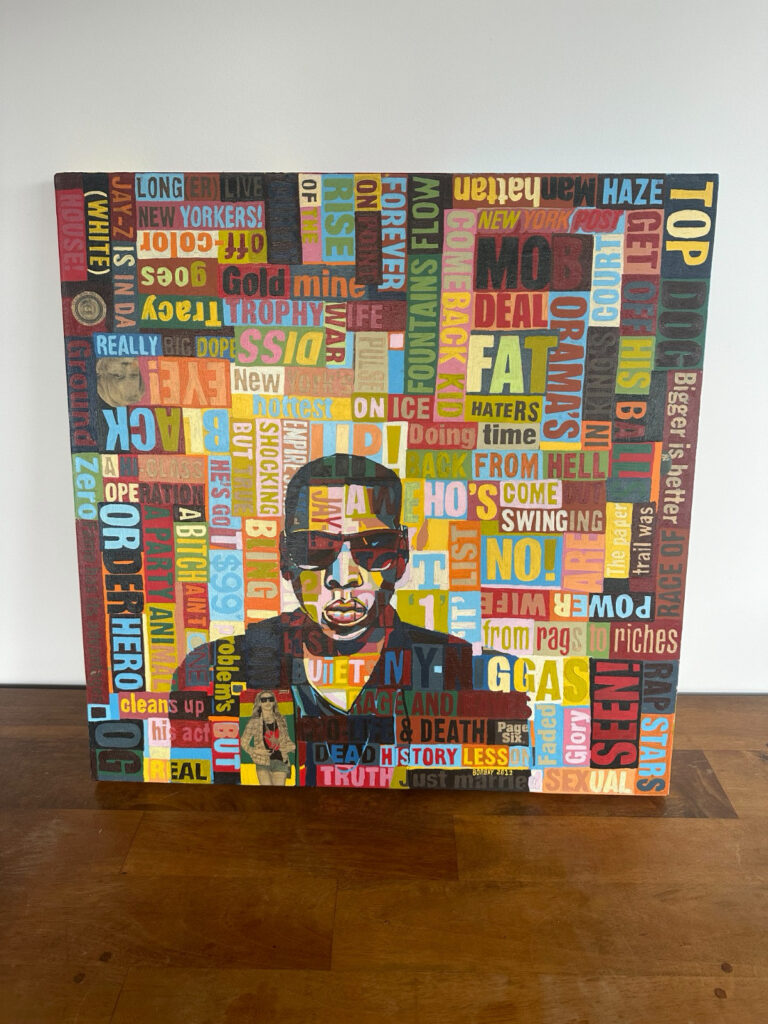
ZOG: This is a really fun story, and in the days when I was at Forbes, working in our old offices in Greenwich Village, I was sitting there one day in my office, and I got a call like through the main phone tree. Somebody had called the Forbes offices and just kind of asked their way through various people until they got transferred to me. And it was this artist named Borbay. He had done this list. He had done this series called “The Kings of Hip-Hop,” and it was like collage-based paintings where he would take clippings from New York Post headlines and kind of cobble them together and then paint over them in this really interesting pop-art sort of way. He had sort of just like uh, picked, I think it was maybe seven or eight of them, and it just so happened that he had like almost completely predicted the top seven or eight people on my Hip Hop Cash Kings that year for Forbes.
We lived in nearby neighborhoods and we’d go out for a beer, and and we became good friends.
One night, he had a party at his house, and we were talking about the painting, and it was there, the Jay painting. And this is probably, I don’t know, maybe 10 years ago. He said, “I think you should have this painting.” This is after the book came out. He’s like, “You wrote the book, you should have this.” And I said, “No, no, no, I think this is, you know, you put your heart and soul into this, this is your profession.” I told him I wanted to pay him for his work. And so we worked out a deal where I acquired it from him.
The painting has hung in my apartment, like various apartments. Started out on the Upper East Side, and then Harlem, and then, you know, Morningside, Upper West. It moved around with me, and my wife, and you know, as I got married, I had kids, and this painting watched over me, writing multiple additional books.
As The Hip Hop Museum progressed towards opening, I was approached early on because I think the Museum had acquired one of Borbay’s other works. I think he donated it to the Museum. And the Museum was really interested in having this JAŸ-Z painting because they knew that I had it. And I wasn’t, I don’t know, I just wasn’t really ready to part with it. I was pretty attached to it, and still am.
As the years went on, I went to the groundbreaking of The Hip Hop Museum, and just felt the energy. And here was this painting just sitting in my office, and maybe a couple of people would see it, and, you know, that was great, but it was just my friends who had all already seen it, and I’d seen it. And it had become part of my life, but I wanted to share it with the whole world. And I realized that, you know, the Museum, I live maybe two miles away from the Museum, so I could go see it anytime. And I said, “Okay, I’ll donate it.” So, that’s how The Hip Hop Museum got the JAŸ-Z painting, and I’m really happy that we were able to get the world’s eyes on it, because I think it’s a really special piece.
AA: What’s one thing that still fascinates you about JAŸ-Z?
ZOG: I think what really fascinates me about Jay these days is his transformation. He’s evolved throughout his career in ways that some artists haven’t.
Starting with ‘4:44’, his last full-length album, he completely changed his outlook. It went from the philosophy of “I will not lose ever” to “a loss ain’t a loss, it’s a lesson.” And you just started seeing him move in a different way, being a lot more focused on social justice, and you know, the next generation.
I’m also fascinated by what he is going to do next. Is he going to put out another album? Is he going to buy a football team? And just the way he thinks about things as chess pieces on his board.
Connect with Zack O’Malley Greenburg through his Substack newsletter called Zogblog.