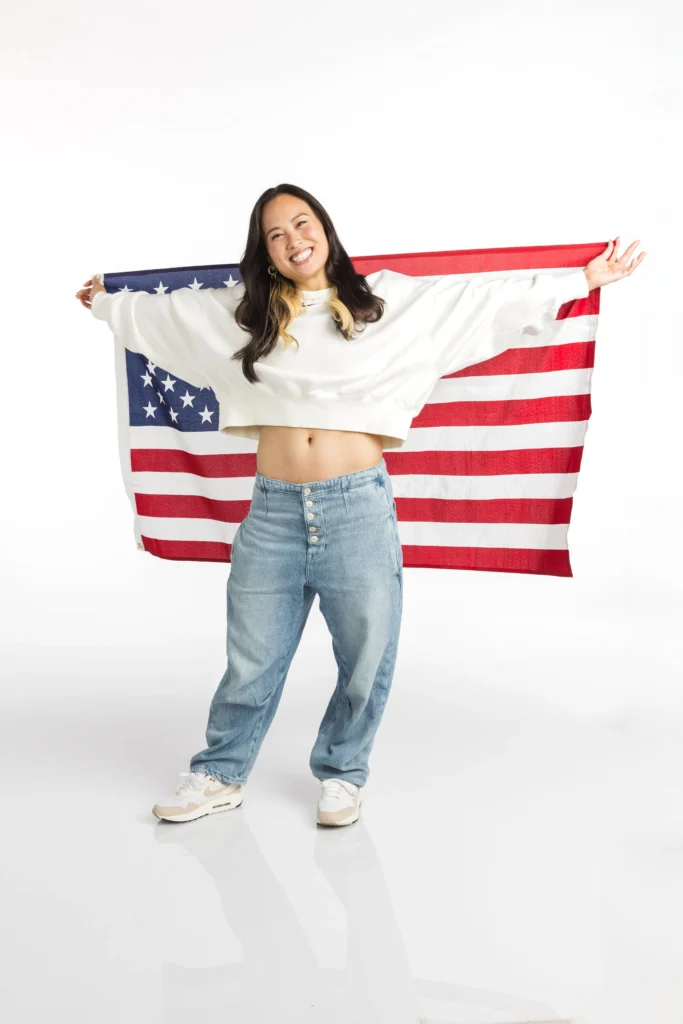
When it comes to breaking barriers and elevating culture, few figures embody the spirit of Hip Hop quite like Sunny Choi. A world-renowned b-girl, Sunny has carved out her own lane in the global breaking community, combining discipline, artistry, and competitive fire. From local cyphers to international stages, she’s pushed the boundaries of what’s possible in movement, inspiring the next generation to dream bigger and move freer.
Fresh off making history as part of breaking’s debut on the Olympic stage as a member of the US Olympic team, The Hip Hop Museum caught up with Sunny to discuss breaking’s Olympic debut, the impact of the art form being on a global stage, and more!
Adam Aziz: What was it like to be at the Olympics and be surrounded by breaking and Hip Hop culture?
Sunny Choi: It was a very special experience to be part of this group that got to debut breaking at the Olympics. In some ways, it’s long overdue. Breaking is such an incredibly physically taxing, physically demanding and challenging endeavour. Here’s the thing. I’m going to use the word sport here because it was in the Olympics, and it is a sport in essence, if you look up the definition of sport. It fits right in. But there’s so much more to it. And that’s what makes it so special that we got to do this at the Olympics because it opens the door to what sport could look like, and it brings in culture and community in a very different way.
I think one of the most beautiful things about breaking being in the Olympics is that breaking is one of the more accessible sports. There are no major financial barriers. Most of us are still practicing in community centers. We pay maybe $5 to go to practice. It’s not something I have to pay into. And so because of that, it’s a really diverse community. To be able to showcase that to the rest of the world is really amazing, because many other Olympic sports are not accessible. You have to pay loads of money to go and get a teacher, to get the uniforms, to compete, all of that. And that’s not relevant for breaking. Breaking is about getting some friends together, some music, and a clean floor. If it’s dirty, that’s fine. We make that work too. Then you get down.
AA: Correct me if I’m wrong, but breaking won’t be at the next LA Olympics, correct?
SC: It definitely will not be in LA. They’re still trying to get it into Australia, but what’s challenging is that the breaking community doesn’t have a lot of money to offer. France included it because it is a major supporter of the arts. And France was one of the early supporters of Hip Hop when it first emerged. And so it has a rich and deep history. They included it because this is something they care about, but in LA, it came down to finances.
AA: If and when breaking returns to the Olympics, what would you like to see changed about the way it is presented?
SC: Good question. I actually haven’t been asked this question. In general, and this is generally an issue with the Olympic sports and sports overall, is that so much highlight and focus goes on just a few athletes. However, there’s so much else that’s happening that doesn’t receive enough coverage, awareness, or financial support. And so, if we could raise awareness around that, it’s not just the athletes we’re talking about, but also the communities associated with them.
Following the Olympics, there was an influx of interest in breaking, with more breakers enrolling in studios. But once it was announced that breaking wasn’t in LA, most of the big sponsors pulled out. I originally thought it would be really nice if we could get a little bit more commercial sponsorship into our world, because it’s so hard to make a living off a dance. It didn’t really work that way, but also on the other side of that coin, we can’t rely on other people. We have to rely on what we can do.
I want to open a nonprofit dance center. Maybe using some of the connections I made in this process to get some support down the road for having a dance center here in New York.
AA: When the Olympics were being held in Paris, breaking was one of the events people were talking about the most. But after the event, have you seen a carryover of interest?
SC: It feels like we’re back to normal right now. I’m a bit more well-known, and I have a bit more credibility in certain circles, especially those outside of the breaking community. It’s helpful because I have more weight to my voice in certain rooms than I did before. I also get asked to do things like this interview.
AA: Yes, breaking sometimes gets siloed from the other elements of Hip Hop.
SC: Outside of just breaking, I care about women in sports and women in fitness. I now have a platform that I didn’t have before, where I can share my thoughts on the things that matter to me.
AA: It’s fair to say that a lot of people came to Hip Hop culture through Rap music. What do you think the place of breaking is in Hip Hop culture today?
SC: I’m not as much plugged into the other areas of Hip Hop. I am deeply entrenched in breaking. In comparison to the other elements, breaking has stayed very street and underground. Breaking pops up here and there, but it hasn’t really gained popularity.
AA: What other element of Hip Hop do you think influenced breaking the most? And then what element do you think breaking influenced the most?
SC: Breaking wouldn’t have happened in this way if it weren’t for the DJs looping the tracks so that the breakers could dance longer rounds to the breaks.
In terms of what breaking influenced the most, that’s hard because I don’t know who is watching breaking and is influenced by breaking. Everyone comes across a video, or if you live in New York, you know somebody or someone’s cousin who breaks.
AA: Why do you think breaking hasn’t had its commercialized moment in Pop culture, with a few exceptions?
SC: It did have a moment like the Michael Jackson ‘BAD’ video. There were also movies where you would see breaking. From what I’ve heard, dancers were not treated appropriately by the commercial industry at that time. And so a combination of that, and probably a lot of them, kind of growing up and having to make a living. If you’re not making a living off of breaking, you’ve got to move on. And so I think breaking started to plateau and decrease in popularity in general.
One of the challenges, honestly, with breaking is that it’s physically demanding, and you have to dedicate a lot of time to it. And you’re practicing multiple days a week to maintain your skills. And if you want to improve, you’ve got to do even more. With breaking, you can barely put a round together initially. And some people don’t even have the strength to do even that. And so, you have to build up and repeat the moves over and over. The learning curve is different than other styles.
AA: When you first started breaking, were there any specific breakers that influenced you?
SC: I started breaking in Philly. The Philly style is slightly different from the New York style. Philly is very rooted in funk music. And then at that time in New York, it was like big moves, fast music, really aggressive. So the two were like opposites.
In Philly, every time I went to practice, people would talk about how you need to know history. You need to know your history. So, although I knew it, I very rarely watched videos. And my philosophy early on was like, I really wanted to move authentically. And I didn’t want to be influenced by everything that I was seeing out there. If I watch something, I might find that I’m doing these motions or emulating things, and becoming generic just because I’m watching all of the content that’s out there, right? Like you conform without meaning to.
I think that’s why I dance the way I dance. There are elements of Philly, and there are elements of New York. But outside of that, it’s like, I break like somebody who is from New York, plus my personality baked in. I’m very analytical, strategic, and a perfectionist. And you see all of that in my breaking.
AA: Back to the Olympics for a second, were there any cool interactions with any other athletes while you were there?
SC: That happened all the time. All the athletes were always excited when we were around. We did this one showcase at the Olympic Training Center, and everybody who was there came out, and they watched, and then everyone talked about it, and so we would show up for training camps, and people would be like, Are you doing another show? Can we watch you practice? People would come through, and they really liked what we were doing. They would talk about how physical and amazing it was to see us move our bodies.
I also had a couple of gymnasts come up to me at the games, and they said, ‘Oh, we wanted to meet you; we think you’re so cool.’ It happened often, and it was really cool because, initially, I was concerned that people wouldn’t see us as athletes. But when they saw us move, it was undeniable to them. Of course, they’re athletes. That was a really cool experience.
AA: Where do you think breaking goes from here?
SC: To be honest, I don’t know. I know that it will always have elements of what we still have today, such as the underground culture; we’ll always have our local battles, community events, and things like that. I don’t think that’s going anywhere. In terms of where it goes in that more competitive borderline commercial space, I guess I feel like it’s kind of up to us to create those spaces.
There are world circuits, international circuits for us to dance in, and a few corporate sponsors that are involved in these circuits. But it’s up to us to make those things happen and to make sure that they’re happening the way we want them to happen.
Even if you walk into a Museum, you can see photos of breakers, but that distills it down to a single moment. And while there’s an energy in that one moment, you’re not getting the full experience.
Follow Sunny Choi on Instagram.