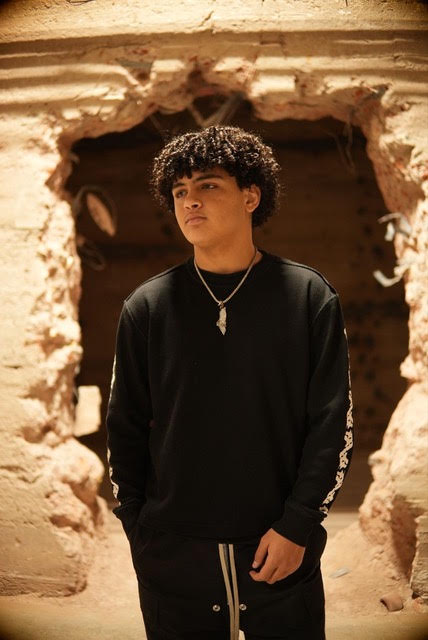
Born in Gaza, 17-year-old rapper MC Abdul first captured global attention in 2020 when a video of him rapping in fluent English, a skill he taught himself by listening to classic Hip Hop, against a backdrop of war-torn rubble went viral.
After navigating a grueling displacement process that eventually led to asylum and family reunification in Northern California, he signed with indie powerhouse EMPIRE.
In the years since, he has built significant momentum: performing at Rolling Loud as the festival’s youngest-ever performer, collaborating and touring with artists like Macklemore, Elyanna, and Saint Levant, and starring alongside Bella Hadid in Mustafa’s “Gaza Is Calling” visual.
Translating acute generational trauma and displacement into sharp lyricism, Abdul is now preparing to release his debut studio LP, ‘Shway Shway, Day-By-Day’, in early October.
The Hip Hop Museum caught up with MC Abdul to talk about his creative process, his Hip Hop inspirations, his upcoming album, and more.
Adam Aziz: You learned English largely through the cadence of classic Hip Hop artists while living in Gaza. When you sit down to write today, what language does your mind naturally draft in first? And do you find that certain emotions can only be articulated in one language versus another?
MC Abdul: I grew up listening to a lot of songs in English. Obviously, I heard Arabic music too, since everyone around me was playing it, but most of what I listened to was in English. So naturally, when I write, I think in English first.
I learned English when I was really young, mostly through Hip Hop, so it honestly doesn’t feel like a second language to me. It feels pretty natural, just like Arabic.
But Arabic definitely hits differently. It’s a very poetic language, and sometimes one word or one saying can have a much bigger meaning behind it. There are certain things we say in Arabic that, when you translate them into English, you understand the words, but you don’t really get the same feeling.
So it really depends on what I’m trying to say and what I’m feeling. Sometimes English says it better, sometimes Arabic hits harder. I use whatever feels right.
AA: “Shway Shway” translates to “slowly” or “bit by bit,” while Hip Hop culture often celebrates rapid ascension and overnight success. Why was patience and deliberate pacing the central message you wanted stamped across your debut album?
MC Abdul: Patience is really key to everything. Everybody you see that’s successful now, at some point they were down bad, or they had to start from the bottom. You can’t rush greatness. You don’t just get everything you want overnight.
For me, it’s about staying consistent, being patient, and just taking it day by day. Sometimes you gotta slow down and realize you’re still moving forward, even if it doesn’t feel like it.
That’s really what “Shway Shway” means to me. Bit by bit, step by step. You gotta keep going and trust the process.
AA: You’ve been embraced as an important voice for so many people at an early age. When you step away from the mic and the industry’s expectations, how do you protect your personal space and stay grounded as a 17-year-old?
MC Abdul: I try to stay humble, stay close to my family, and keep good people around me. I’m still 17 at the end of the day, so I’m still learning and figuring things out. I try to keep myself in that “Shway Shway” mindset, take everything day by day, stay grounded, and keep working on becoming a better person and artist.
AA: Your recent stage presence has crossed borders rapidly—collaborating with artists like Elyanna, Saint Levant, Tamer Nafar, Anees and Macklemore, and sharing a stage with South Asian icon Atif Aslam. How have these diverse musical traditions shaped your upcoming LP?
MC Abdul: Working with so many amazing people definitely taught me a lot. Seeing their work ethic and mentality, there’s always something u can take from them. I take inspiration from experiences in my day-to-day life, and I really got personal with this album about my life in the last few years.
AA: In Mustafa the Poet’s short film and music video for “Gaza Is Calling,” the emotional focus was heavily visual and cinematic. When translating your lived reality into a 3-minute song versus a screen role alongside figures like Bella Hadid, how does your approach to storytelling change?
MC Abdul: You can explain your feelings in so many different ways: in music, acting, or drawing and painting it depends what you’re most passionate about, and to get an opportunity like this to be apart of Mustafa’s music video and have my first acting experience with Bella Hadid is really amazing, and I can’t wait to have more acting opportunities and I do see myself doing it.
AA: Media outlets frequently describe you as a “peace-seeking warrior.” Hip Hop has roots in aggressive battle culture, yet your message centers on liberation, survival, and reconciliation. What does modern “warrior energy” look like on a beat when the ultimate objective is peace?
MC Abdul: I think being a warrior is about having strength, staying true to yourself, and not giving up no matter what life puts in front of you. For me, that energy comes through my words and my music.
I’ve been through a lot, but I don’t want to put more negativity into the world. I want to take what I’ve experienced and turn it into something positive, represent my people, and give hope to anyone going through their own struggles.
So on a beat, I’m still gonna bring that energy, that confidence, and those hard bars, but the message is always bigger than that. This isn’t just about me, or just about Gaza and what I’ve been through. It’s about the youth and this new generation around the world who want change. The world is getting smaller and more connected, and I feel like our generation has a lot to say about the future we want. I just want to use my voice to say what I feel my generation is feeling.
AA: You studied golden-era lyricism, in which multi-syllabic schemes and boom-bap cadences dominated. With modern Hip Hop leaning heavily into melodic trap, ambient space, and drill rhythms, how do you bridge the classic 90s storytelling tradition with the production trends shaping charts today?
MC Abdul: I listen to all kinds of music, or at least I try to, because I feel like you can get inspired by anything. I grew up listening to old-school rap, and I still listen to it, but I also listen to a lot of R&B and artists like Drake, Ye, and Tory Lanez. I like trying different sounds and different types of beats and seeing what I can do with them.
I think you can take what you learn from both sides. I can bring that old-school storytelling, the bars, the wordplay, and the way I grew up listening to Hip Hop, but put it over a completely different sound. I don’t want to limit myself to one type of beat just because that’s what I grew up on.
At the end of the day, the production can change, the flow can change, the sound can change, but whenever I’m writing something with a message, I want it to be how I truly feel. That’s the part that stays the same. I’m just trying different sounds while still keeping my story and my voice.
AA: “Missing Home” on the new album is a pretty powerful record. Talk to me about making that record and the emotions and process behind it.
MC Abdul: “Missing Home” is actually a hopeful song for me. It’s about sticking with it through the tough times and still having a vision, even when you can’t see the way forward. It’s me speaking from the heart about missing Gaza, missing my family, and everything I left behind.
For that one, I wanted to try something different. I got more into melodic rap and singing, and honestly, I’m at a point right now where I really love singing too, maybe even more than rapping sometimes. So I wanted to let myself do that and not be scared to try something different.
I think the song’s emotion needed that. It’s not just about missing home and being sad about it. It’s about missing where you come from, carrying it with you, but still moving forward and believing there’s something better ahead.
AA: The Hip Hop Museum will open in the Bronx, New York in 2027. Why do you think it’s important the younger generation learns about the history and pioneers of Hip Hop culture?
MC Abdul: It’s important for everyone, especially the younger generation, to know how Hip Hop started and where it came from. Hip Hop is not just music; it’s art, and it’s a culture that has changed millions of people’s lives.
For me, I learned so much from the artists who came before me, and without knowing their stories, you don’t really understand the culture the same way. They opened the door for all of us, so I think it’s important that we respect that history and keep it alive for the next generation.
Follow MC Abdul on Instagram.