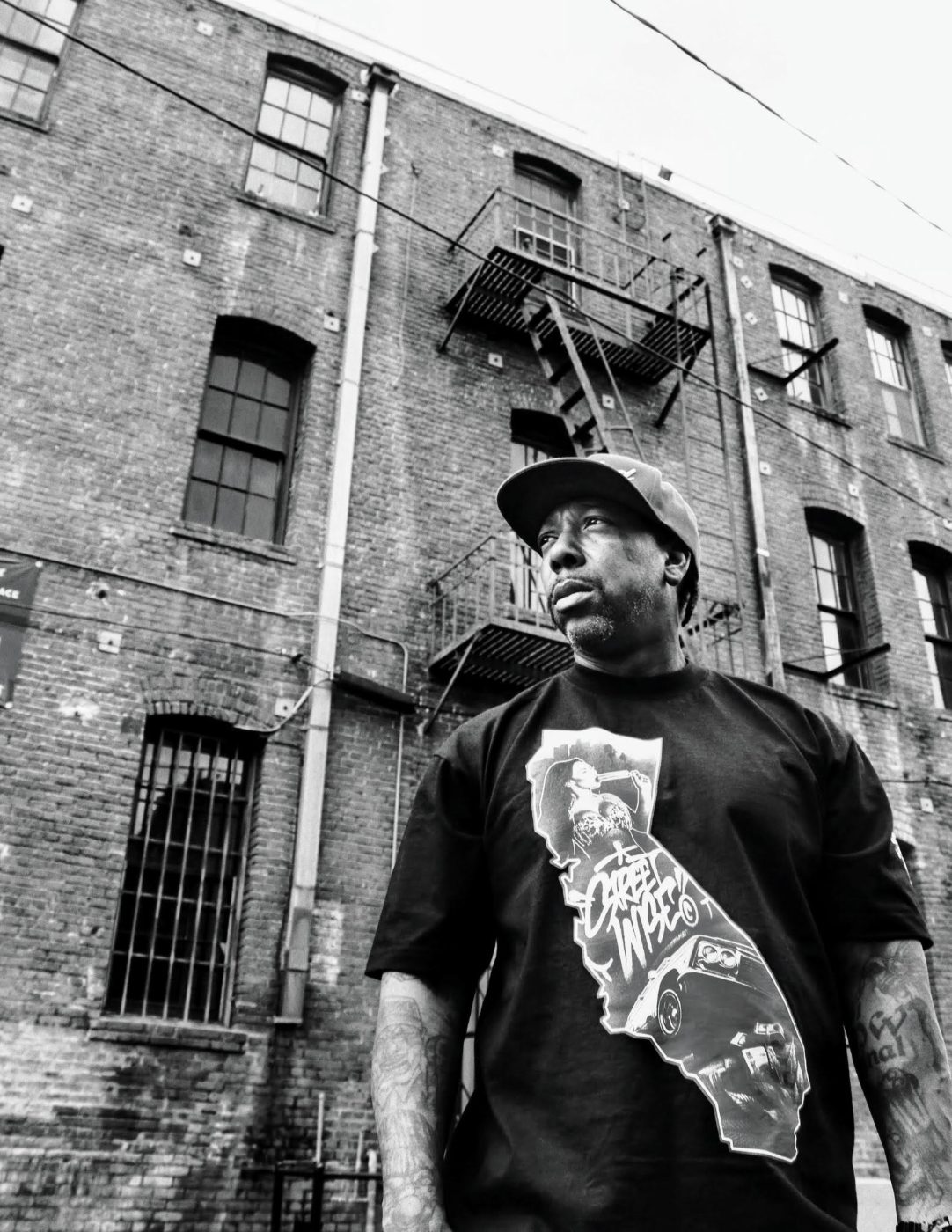
Few voices in West Coast Hip Hop are as instantly recognizable as MC Eiht’s. As the frontman of Compton’s Most Wanted, the Compton native helped put his city on the map in the late ’80s and early ’90s with vivid street narratives like “Growin’ Up in the Hood” and “Hood Took Me Under.”
His reach quickly went beyond music. In 1993, he brought A-Wax to life in the Hughes Brothers’ Menace II Society and delivered the soundtrack’s “Streiht Up Menace.” A decade later, he introduced himself to an entirely new generation as the voice of Ryder in Grand Theft Auto: San Andreas.
Long respected on both coasts, Eiht has worked with East Coast heavyweights like DJ Premier, and he recently released The Story of My Life, a new album featuring Pete Rock, Conway the Machine, Dave East, B-Real, and more.
The Hip Hop Museum caught up with MC Eiht to talk about Ryder’s legacy ahead of Grand Theft Auto VI, bringing A-Wax to life, his deep ties to the East Coast, The Story of My Life, and more.
Adam Aziz: Grand Theft Auto VI drops next month, and more than 20 years later, Ryder is still one of the most talked-about characters in gaming history. How do you feel about that character being a doorway for a whole generation of kids to discover Compton’s Most Wanted and you?
MC Eiht: It was a great experience. Like you said, it introduced me to a new generation of youngsters, especially on the music tip. It introduced me to a younger crowd who were into gaming and streaming. So it definitely opened the door and bridged the gap between the newer generation and hearing about MC Eiht and Compton’s Most Wanted.
I was able to participate in a few parts of the game, first being on the radio stations and then being able to voice and portray Ryder in the actual game. That just took it to another level, and it opened up the doors on the whole gaming industry. Grand Theft Auto was big.
AA: Menace II Society is one of my favorite films, and people still quote you from it 30 years later. How much of A-Wax was written for you by the Hughes Brothers and the writers, and how much of it was just you?
MC Eiht: Of course, I had a script, but with the reality of the character, and being authentic in trying to bring him to life, I was able to use some influences that weren’t in the script. I was able to ad-lib a lot of A-Wax’s storyline, seeing where I had come from and the walks of life: being involved in gangs, the movie portraying gang life, and living in South Central. I ad-libbed a lot of stuff that I felt would make the character more authentic.
AA: It was rare for West Coast artists in the ’90s to be working with DJ Premier. What did East Coast MCs, producers, and Hip Hop heads get about your music that maybe some LA people didn’t?
MC Eiht: I just think it’s about trying to be original with your music. I built relationships over time with a lot of East Coast artists, being one of those early artists who used to venture to New York to do promos. A lot of the major labels were based in New York, so any time you got signed or got ready to do another record, you would always find yourself there.
I listened to a lot of East Coast music coming up, so meeting guys like Premier and Guru, Pete Rock, and Stretch and Bobbito gave me a connection to the East Coast. My music always tried to reach the common dude, whether he was West Coast or East Coast. We were all going through situations that I tried to explain in my music. Then being able to reach out to East Coast producers to do stuff for my projects, I think that’s where the connection and the love came from.
AA: You were part of the generation that put Compton on the map in the first place. Over the past few years, Kendrick took it back in a way we hadn’t seen from the West Coast since the ’90s, whether it was The Pop Out or the Super Bowl halftime show. As someone who helped build it, what was going through your head watching all that unfold?
MC Eiht: It was great for the young generation to put their mark on Hip Hop. I thought it was good for him to try to unite certain groups of people with The Pop Out, and just to witness West Coast music, and Hip Hop period, sustain for 50-plus years. It’s been a long way coming, but we’re able to reach those heights now. Being somebody who introduced the world to West Coast music and Compton, to see somebody carry on the torch for Compton, it was a proud moment.
AA: On Which Way Iz West, you talked about how the game had changed, with internet forums constantly crowning the next new thing. How have your takes on the game evolved since then?
MC Eiht: It’s come a long way, even from 2007 to 2017, and now with the use of AI, different kinds of genres, and people being able to set their own pathways. It’s a blessing and a curse. The internet is helpful in some ways, to get your music out, promote, and reach people you wouldn’t necessarily reach, whether you’re independent or signed to a major label. So it has its uses, but you have to be careful and not get too out of hand with it. You want to keep some originality in the music.
AA: Who are you rocking with these days, especially on the West Coast?
MC Eiht: I try to keep my ear to the street when it comes to new artists. The Conways, the Dave Easts. I listen to a little Nipsey, a little AZ Chike. I still listen to Kendrick, and I’m still listening to a lot of old school to try to keep that balance.
I don’t have a particular favorite, but any time somebody drops from the West Coast, whether they’re independent or major, I give them a fair listen. I try not to be biased. There’s an 80 percent chance that if you’re a new artist and you put out music, I’ve heard at least three or four songs. So I’m listening.
AA: Your new album, The Story of My Life, just dropped. My favorite track so far is “Pistols & Palm Trees.” The production is so dope, and the record really feels like LA. It’s also one of the most descriptive tracks lyrically. Is it one of your favorites?
MC Eiht: “Pistols & Palm Trees” is one of my favorite records. My boy Rob T produced that one. Like you said, it gives you that time-and-place feel, and the music lets you really get into it and hear what I’m explaining in the song.
It’s growing up in LA back when I grew up, and it’s trying to depict the scene. When you listen to it, you can think about the sadness the song can bring, the excitement it can bring, the different elements that take you up and down. It’s describing a young man’s vision living back in the early ’80s, coming up in poverty and single-parent homes, and looking forward to greater times.
AA: I’m from Toronto, and when I was nine or 10 years old, I was listening to you and everybody from the West on my cassette deck, thinking, “I need to be there.” How does it feel knowing your music was connecting with people who couldn’t be further away from where you were?
MC Eiht: That’s what I tried to make music for: to connect with people who weren’t in Compton. No matter where you’re from, there’s always something we all go through that we can all relate to. I wanted to connect with dudes in Toronto. I wanted to connect with dudes in New York, Texas, Chicago. I didn’t want to glorify certain sh*t; I just wanted to talk to everybody. Even if you were in Africa somewhere, you could put on the song and relate to it. We was hungry, me and moms, struggling for money. That’s everybody’s situation at one time.
We had those good times as youth, as adolescents, as young adults, but we had bad sh*t too. Sometimes it just happened. So my songs would bring those times where it’s like, “Damn, Eiht said something that we went through last week.” We got pulled over by the police last night. My homeboy got took to jail for being drunk in public. We’ve all had that sh*t happen.
I get a good feeling when people tell me, “Man, your songs helped me make it through,” or, “I was in jail and I used to listen to your music and it gave me hope.” It’s a good feeling when you can connect with people like that.
AA: I spoke to Mathematics from Wu-Tang about their Rock & Roll Hall of Fame induction next month, and he still felt it was very important that Hip Hop has its own museum. Why do you think it’s important that Hip Hop has its own space?
MC Eiht: Because it’s our culture, it’s our legacy. A lot of people doubted our culture in the beginning, and then people jumped along. No disrespect to the Rock and Roll Hall of Fame, and I’m glad they accepted people like Run-DMC, Wu-Tang, and Public Enemy. But this was our culture that a lot of people didn’t even want to see withstand. So a home base for our own culture is very important.
It’s not just sprinkled in with other sh*t. It’s a place where you can go, and it’s all about the legacy of Hip Hop from the beginning until now. These other places are only going to give you a small space. This is a space for all of Hip Hop’s importance, from the smallest artist who made an impact to the biggest. That’s what a spot like this can represent.
Follow MC Eiht on Instagram.