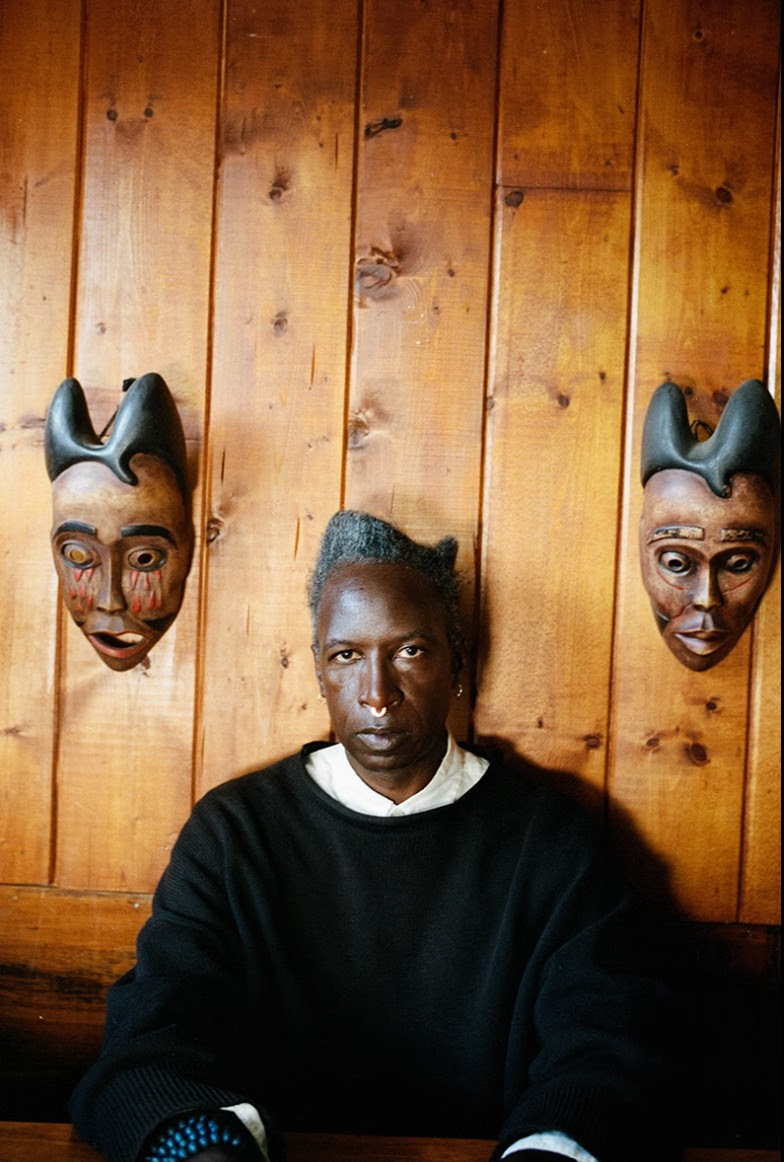
Saul Williams is an American poet, musician, and actor renowned for fusing spoken-word poetry with alternative Hip Hop, industrial rock, and avant-garde performance.
He first gained widespread acclaim after starring in and co-writing the award-winning 1998 independent film ‘Slam’, which captured the fiery energy of the Nuyorican Poets Cafe scene.
Over a career spanning more than two decades, Williams has published influential poetry collections, including The Seventh Octave and Said the Shotgun to the Head, alongside groundbreaking musical releases, such as his Rick Rubin-produced debut ‘Amethyst Rock Star’ and the Trent Reznor-collaborated ‘The Inevitable Rise and ‘Liberation of NiggyTardust!’.
Williams will release his new album ‘Leap Life’ on August 28th.
The Hip Hop Museum caught up with Williams to talk about the boundaries between poetry and MCing, his thoughts on Eminem, what he learned about 2Pac performing in ‘Holler If Ya Hear Me” on Broadway, and more.
Adam Aziz: After ‘Slam’, where did you see the boundary between poetry and MCing, and how do you think spoken word has shaped modern-day rap?
Saul Williams: Well, you know, I don’t think any of us would argue about the role that Gil Scott-Heron and The Last Poets played in laying the groundwork for what would become Hip Hop. If we follow that line of thought, we can say that part of Hip Hop, part of MCing, was inspired by poetry and poets.
So, even though I think the spoken word movement kind of arrived unexpectedly in the mid-90s, I think it was an inevitability that a generation that had grown up cultivated through Hip Hop to pay attention to wordplay and linguistics and all of this stuff would be tuned in enough to be able to subtract the music and enjoy the words themselves. So it made sense.
My evolution was like that. Like, I started identifying as a rapper at a young age. I was very inspired by KRS-One, very inspired by Rakim…very inspired by a lot of cats—LL Cool J, you know, Public Enemy, tons of stuff. And when I would battle—when I would battle, I’m talking about in the ’80s—when I would battle in school at the lunch table, a lot of times I would get so into the kind of wordplay that I was doing that I’d be like, “Yo, yo, yo, no beat, no beat.” Because I would want people to hear where the language was going.
And so I point to that to say, without realizing it at the time, I was on the path already toward a sort of like spoken word delivery and all this sort of thing. And yeah, at the time for myself, my relationship to poetry was also weighted by literature. I was very into theater, reading, and all that stuff. So my lyrics and lyricism were also informed by what was happening on the page and audio-wise.
AA: How were the two distinguished, MC’ing and poetry?
SW: I would say that the main distinction that I felt in that ’90s Rawkus era with, you know, the rise of the popularity of poetry, and then you had this kind of like boom-bap stuff that was going on with Hip Hop and what have you… I felt as if the distinction to be made was that since Hip Hop was so deeply rooted in its competitive side—that, you know, every rapper wanted to claim to be the best rapper—so there’s a lot of ego involved. And poetry was the subtraction of the ego.
And what I found, as someone who had identified as a rapper at first but then more identified with poetry, was that rappers who might not have greeted or been cool with other rappers were cool with me. Because I was not a part of the competition, you know? They were like, “I love your poetry, bro. I love your poetry” But they wouldn’t necessarily go up to another rapper they were up against like, “Yo, yo, you’re amazing.”
At the same time, I also know that when we were defending Hip Hop against the early naysayers, you know, whether it was white boys who were like, “It’s not even music, they’re just talking,” or our parents who would be like, “It’s so crass.” Our defense was always: “Well, this is poetry. This is the poetry of the streets.” Rakim and KRS-One both identified as poets. “R.A.P. is Rhythm and Poetry”—you know, that’s what Rakim would say, and KRS identified as a poet as well.
AA: What did starring in ‘Holler If Ya Hear Me’ on Broadway teach you about Pac’s songwriting craft and who he was as an artist?
SW: I mean, it’s unquestionable how brilliant Tupac was and how clear he was at an early age on the connection between politics and music. You know, this is someone who identified as a communist at a young age. It’s also someone who loved Broadway musicals, who knew all the words of ‘Les Mis’ by heart, and would come home from school and put on the ‘Les Mis’ soundtrack and sing along with it. He was balanced in his appreciation of music, art, theater, and politics.
One of the biggest learning curves for me while working on the ‘Holler If Ya Hear Me’ project was that August Wilson started that project. You know, one of the most esteemed African American playwrights in recent or contemporary theatrical history. He passed while he was working on it, but he had already spent a decade going through Tupac’s music with his mother, Afeni, and crafting the play’s story based on the stories Tupac told in his music.
That project was exciting for the family because they knew how much Tupac had dreamed of being on Broadway, of writing a musical, and of acting on Broadway. And so the trajectory of seeing his work take that stage, as a kind of family event, I think was very important for the family because there’s so much about what Tupac became and what became of Tupac and his legacy is so much connected to gang violence and east vs. west coast, that a lot is lost in the midst including his love of poetry, and his love of theater.
AA: Hip Hop is traditionally broken down into four elements—MCing, DJing, graffiti, and breaking. Do you see these as separate disciplines, or as a single holistic culture where every element shapes the others?
SW: I look at those as combined elements. I’m lucky enough to be born and raised in New York at a time where I got to experience all of that. I wasn’t a graf writer, but my cousin, who lived with me, was. And so I would see him create a new alphabet every week, or master his alphabet. He tagged up walls. I was on the breakdancing and rapping side. Other friends were DJing. So all of those elements to me, it’s the whole spirit of it combined.
The thing that made me start rapping was T La Rock’s “It’s Yours,” which is the first song that Rick Rubin ever produced. It’s also the first song that took what was happening in the clubs, which was people rapping over breakbeats, and put it on vinyl. Because when MCs at that point were going into the studios, they were bringing bands, they were recreating kind of like disco sort of stuff and baselines, but nobody was really rapping over breakbeats as it was happening in the clubs. And that was Rick’s contribution at that time, to say like, “The shit that’s happening in the clubs is what we need to do on vinyl.”
I heard that: “Commentating, illustrating, description giving…” I loved that he was playing with language. I was in third grade, but for me, I was already reading Shakespeare and doing school plays, and one of my favorite pastimes was reading through the dictionary and finding words I didn’t know. And so that idea of taking big words and putting them into raps appealed to me. I started rapping then. And then I would try to rap in French because I had a French class, I tried to rap in Old English because like I said I was reading Shakespeare. I started trying to play with all these things.
And you know, nobody asked for this, but I’m going to say it. I remember Eminem when he came to Lyricist Lounge. When he came, he had just a mixtape and the song about, like, dumping his baby mama’s body, her being in the trunk and the whole nine, and us being like, “Yo, this white boy is amazing.” But with the evolution of his sound. I feel like a dude like him makes music for people who are not interested in dancing to Hip Hop.
AA: What do you mean?
SW: What I mean is that we’re supposed to be like, [mimics fast rapping] like, “Wow.” We’re supposed to be wowed by the wordplay and all that type of stuff, but it feels more like bob-your-head music.
I’m not talking about the Dre stuff, because obviously the Dre stuff had that feeling of like we’re dancing and the whole nine. But his production and his evolution, to me, are more aligned with, like, “this is Hip Hop for rappers, or for people who aren’t that interested in dancing.” For me, Hip Hop music has always been highly danceable. Highly danceable. And that’s something that I vibe with. Which is why I’ve never had any beef with mumble rappers. Like, to me, like with the mumble rap, I hear the music, I hear how they’re responding to the music, and I hear the hype within it, and I’m like, “Yeah, we’re dancing. I get it.”
AA: When you mention Eminem, do you mean that positively? Because I agree that he stopped trying to make mainstream ‘hits’ years ago. For his last few albums, it feels like he’s just flexing his technical lyrical ability—aside from the occasional standout track.
SW: I don’t listen to that. But I’ve never liked his voice, so I don’t mean it in a positive light. And for me, as an MC, I really need to like your voice. I say that to counter the idea of people who put people on lists of top fives and what have you, and all that type of shit. I call it a lack of sensibility when it’s just about the lyrical, because there’s tons of people who have lyrical ability. I would put the lyrical prowess of Pharoahe Monch against Eminem. Pharoahe Monch is crazy, lyrically. But beat-wise and music-wise, I also feel like there’s something where their relationship to the music is—there’s a reason why there’s dancers on stage.
AA: It’s an interesting perspective.
SW: I’m speaking of that only in relationship to—you asked about the elements and I tell you I see them combined, and for me, you know, someone might think that I’m way more interested in lyrics.
AA: I think a lot of people would think that given you’ve eschewed the mainstream over your career.
SW: I vibe with energy and vibes. Like Future, where I feel the energy and vibes, and I’m moving, it’s undeniable. I could take the time to be like, “What the f*ck is this person saying?” But if the music overpowers it, and the flow and the vibe overpowers it, I never reach that point. And that’s a positive for me. You know what I’m saying? Um, in the same way, in the older days, you know, like me listening to like Project Pat or something. You know, where I’m just like, the way this cat is flowing over this music is crazy, it’s insane. And I’m feeling it, and I’m about to crash my car because it’s so f*cking hard.
So what I’m saying is that an over-emphasis on lyricism without, without paying attention to the other elements—to the beats, to the elements that make us dance- is not of interest to me. I’m interested in the elements that make you dance, and I really don’t care how you get there.
AA: Why is now the right time for the new album ‘Leap Life?’
SW: I actually never stopped working. During that gap, I co-wrote and directed my first feature film, ‘Neptune Frost’, scored it, and released the ‘MartyrLoserKing’ graphic novel.
Music is always part of my process. Since COVID, I’d been compiling songs and sounds spanning different phases, experimenting with programming South African Amapiano, creating a film-narration vibe, and chopping up Vivaldi, which brought me back to singing. When I played these varied demos for my producer, Carlos Niño, I wasn’t sure if it was one project, three separate albums, or if we should start fresh. Carlos saw the vision immediately, sequenced my demos to tell a cohesive story, and we kept that exact sequence for the final album.
As for “why now,” while I use my platforms to speak out and amplify oppressed groups, such as Palestinians, I believe my greatest power to effect change lies in art. We won’t achieve the world we’re fighting for unless everyone plays their part. I’m not a critic who complains about what other artists aren’t saying; I’d rather lead by example. ‘Leap Life’ is my contribution to this moment, reflecting what we’re witnessing and putting my best work forward to help inspire necessary transformation.
AA: Why do you think it’s important Hip Hop has its own physical Museum space?
SW: I think as time progresses, we have a more profound understanding of what it is that we’ve created and contributed to and participated in. That’s what’s crucial about reflection and spaces for reflecting on culture.
There’s a lot to celebrate in Hip Hop; there’s also a lot we have to grapple with, like I was saying about the role Nixon played in co-opting Black Power and making it about Black capitalism. And Hip Hop has been one of the hugest proponents of Black capitalism in its modern sense, and that’s something we have to push back against. It’s on us to take our music back. And by that, I mean to use it to uplift the culture and to transform the culture and to remember the everlasting power and essence of music, which has been born of ceremony. Music is born of ceremony. We call MCs the masters of ceremony, and so we have to remember what the ceremony is. The ceremony is not just a get-rich plan. We’ve gone from celebrating innovators to celebrating how much money someone has made using the art form. And we miss the point when we do that.
Follow Saul Williams on Instagram.